


The Place Your Customer Belongs
More than a high street, a mall, or a “mixed-use space.” Some areas have an identity, a sense of self, and a sense of belonging. Retail, sports, culture, leisure, workspaces, living - all present, but adding up to more than their parts. We can tell a neighbourhood from a development. We know it when we see it. Soho, Shoreditch, the Marais, Williamsburg, Kreuzberg.
The places above have been honed over the years. Bumped, bruised, adapted. They share an artisanal past, dense housing and industrial mixes, and being ignored by the ‘posh’ parts of their cities. These areas have ‘emerged’ and been ‘discovered’ (both patronising perspectives), but if you had to create the next amazing place, how would you go about it? Excellence is easy to recognise, but not to achieve.
We are looking to create an identity, and foster a sense of belonging and ownership.
At CustomerX we look across sectors at customer contexts - real-world settings where retail, hospitality, finance, health, media and leisure compete for the same person’s time and money. I’ve looked at airports and health hubs in earlier pieces. This time: physical places. Identity is what makes a place worth visiting, worth living in, worth investing in - so identity is an asset. Someone is building it, someone is funding it, and someone is capturing the return. The question for any commercial leader is which of those three roles they are playing.
In this piece:
Placemaking
Identity
Patient capital, and the balance sheet to wait
The Olympic arc
Culture as infrastructure, not decoration
The deliberate street
Olympia and CustomerX
Mise en place - the ingredients
Placemaking
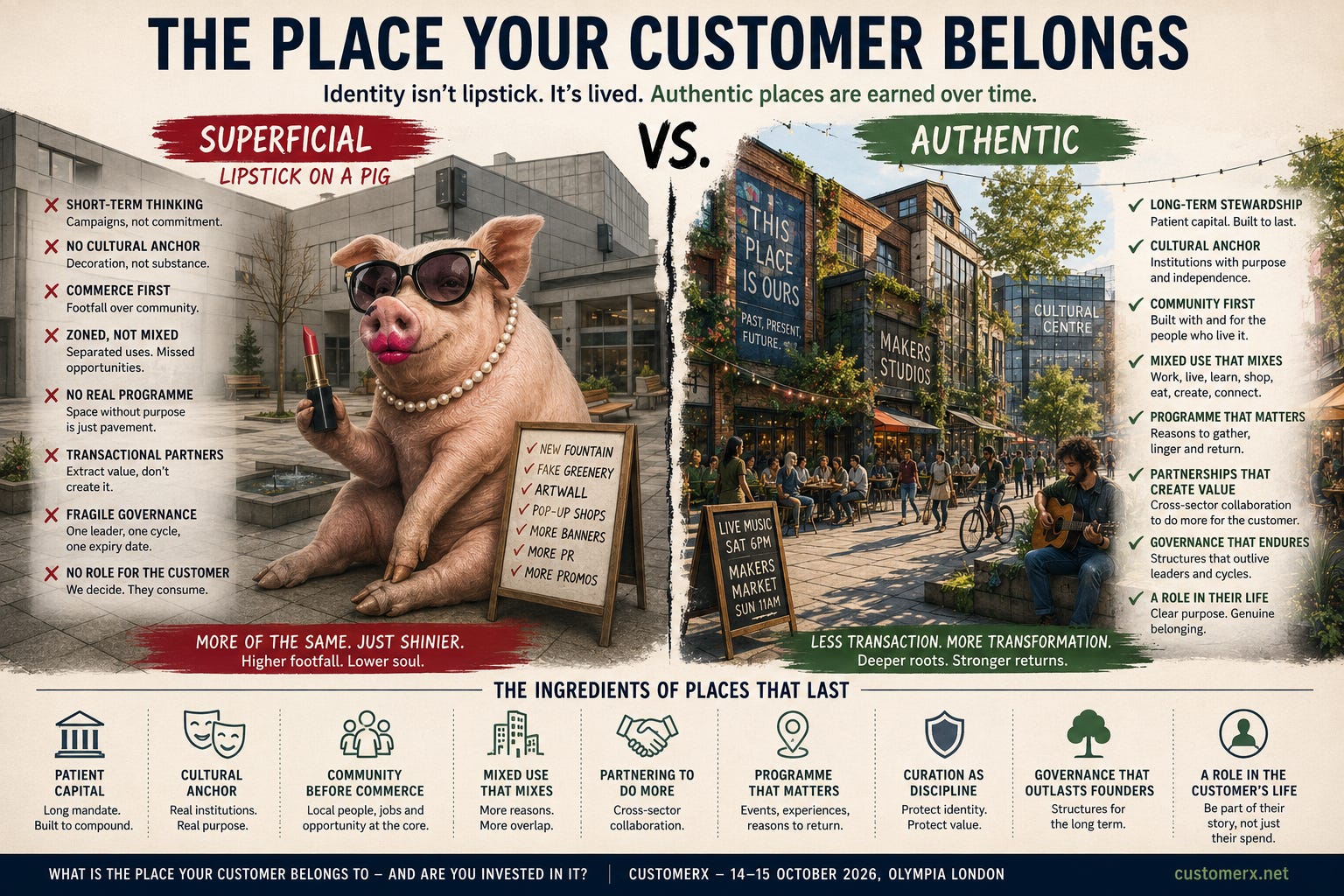
“Placemaking” is such a ‘developer’ and town-planning coverall term. It has a bit of a “lipstick on a pig” reputation for plonking a park bench next to a water feature to soften the slab housing, or trading a school as planning gain to get an office building approved. However the Project for Public Spaces (since 1975) defines the term as:
“a collaborative process by which we can shape our public realm in order to maximize shared value. More than just promoting better urban design, placemaking facilitates creative patterns of use, paying particular attention to the physical, cultural, and social identities that define a place and support its ongoing evolution”
Commerce plays a part in this (people need workspaces, retail and leisure), but we also include health provision, culture, activities, education and interaction. This cross-category mix is why it’s of interest for CustomerX.
Identity
For a space to have an identity, it needs edges to shape it. Not to contain, nor to exclude, but to define. The cell walls, if you like. Currently this is often the borders of the brownfield site being developed, but could equally be the catchment of a development zone.
Identity is created by the accumulation of consistent signals over time: the mix of operators, the type of events, the quality of public realm, the people who work and live there, the cultural institutions that anchor it, and -- critically -- the businesses that choose it because of what it means rather than because of the footfall numbers.
Identity is therefore the gradual accretion of actions and behaviour rather than marketing claims. A neighbourhood’s identity is, in this sense, a self-fulfilling proposition: the right operator moves in because of the identity, and in doing so deepens it.
It is also fragile in a specific way. Identity is destroyed faster than it is built. One wrong anchor tenant - a category killer that optimises for volume over character - can dilute in two years what took twenty to establish. This is why the landlord’s curation role is genuinely commercial, not aesthetic. This is why the “Starbucks moment” (when a global chain jumps into an up-and-coming area) feels extractive rather than contributive.
In March 2025, Norway’s sovereign wealth fund paid £570m for a 25% stake in Covent Garden and £306m for a 25% stake in Grosvenor’s Mayfair estate -- £876m in London streets in a single quarter, by capital structurally obliged to think in decades not quarters. That is what identity looks like on a balance sheet.
Patient capital - and the balance sheet to wait
Since identity and value build slowly over time, the owners or custodians need a long-term vision. This could be neglect (a laissez-faire landlord ignores dilapidated areas, allowing artists to have studios cheaply - Spitalfields), or transgenerational wealth (the Crown Estate), or public bodies (Olympic committees, regional development bodies).
Shaftesbury Capital has managed the West End not just as a retail portfolio but as a globally-recognised “identity estate” - over 250 new concepts introduced across Covent Garden, Carnaby Street, Soho and Chinatown over decades. The Crown Estate manages Regent Street and St James’s on the same logic: curating tenants as identity stewardship. This is a function of wanting continuous growth over a generational timeframe, knowing that commercial return follows value accretion.
Identity cannot be “installed” at speed, nor willed into being by advertising claims. It requires time, genuine community presence, and the willingness to let neighbourhood coherence take precedence over any individual operator’s short-term demands.
The Olympic arc
Turning to the government sphere, the London 2012 Olympics gave the UK a reason for coordinated investment in a public good, with planned long-term benefits. It was a sporting and civic story. Zaha Hadid’s aquatics centre, Anish Kapoor’s Orbit - a spectacular set of buildings, but what of the legacy?
Part of the answer is East Bank: V&A East, Sadler’s Wells, BBC Music Studios, UCL, London College of Fashion. A £1.1bn cultural district funded by £385m from the Mayor, £151m from Government, with the rest from partners, residential land sales and philanthropy.
Public investment has shouldered the risk on the cultural anchor; private returns can be made on the surrounding property and commercial activity. Together, these cohere into an identity, energy and vibrancy for the area. East Bank projects £1.5bn in economic benefit and 2,500 jobs, none of which flow from the institutions themselves but from the activity their presence enables.
Publicly funded culture is not a subsidy. It is the anchor investment that makes adjacent private capital viable.
Culture - infrastructure, not decoration
Culture is what makes a place legible - it signals what the space is for and who it is for. Without it, a development is real estate. With it, it becomes a place where people feel they belong.
As department stores have retreated, culture has moved into their structural role in the most successful regenerations: Factory International in Manchester, Battersea Power Station’s arts programme, and the Barbican as the defining identity of an otherwise corporate quarter. Cultural programming generates identity density - a concentration of meaning in a place - that retail and hospitality operators then monetise. The culture rarely captures the majority of the return it creates.
I mentioned department stores, and this is a segue to Oxford Street - surely the world’s most famous street of top department stores. With the demise of Debenhams, House of Fraser, BHS, and the closure of other flagships, the street was looking rather deflated. I’d written previously about the planned pedestrianisation and redevelopment, but it’s interesting that the discussion has been framed almost entirely in terms of urban realm and transportation.

The deliberate street
Simply increasing access doesn’t create a sense of identity.
Oxford Street, with 500,000 daily visitors, still doesn’t convey what it is for, or who it is for. Pedestrianisation removes the cars by end of summer 2026. It does not supply the answer. Higher footfall in an identity vacuum is not a solution - it is a more expensive version of the existing problem.
The urban landscape, access and renovated buildings will certainly freshen the street. However, it’s noticeable that culture is largely absent from the planning. There are street activities that take advantage of the pedestrianisation, but the mix of culture, living and learning that we see in East Bank is not in place.
Another major central London development has been the renovation of Olympia - also the first home of CustomerX - bringing business and consumer events together with entertainment and leisure in a £1.3bn redevelopment.
Olympia and CustomerX
British Airways opened BA ARC at Olympia on 16 June 2026 - a 3,800-capacity music venue. BA Club members get ringfenced ticket allocations at every show; 10 Avios per £1 at selected bars and restaurants across Olympia from 22 June; the British Airways Wing lounge inside the venue echoes their airport offering. They are weaving loyalty currency into a destination’s economics at the moment its identity is still forming.
CitizenM and Hyatt Regency are both opening hotels as part of the same transformation - making the same bet: the guest in a place with a forming identity behaves differently, and spends differently, from the guest in a generic four-star near a transport hub. CitizenM+ members can use the hotel as a drop-in workplace during the week, blending overnight stays with daytime experiences - another cross-sector layer in the “more than just one thing” model.
CustomerX is at Olympia on 14-15 October 2026 because Olympia is the live case study. A 140-year-old identity renegotiated in public, with every sector taking a position. The question for every leader in that room: what is the place your customer belongs to - and are you invested in it?
Mise en place - the ingredients
Chefs use mise en place to mean having everything ready before service begins. What follows is not a formula - genuine neighbourhood identity has never been formulaic - but the ingredients the most durable examples share. A checklist for moving from “having a presence in an area” to “creating and sustaining an identity.”
Note that not many retailers, brands and businesses have the deep pockets to drive or create this alone. Rather, it’s a list of considerations: how to be a good partner, a sympathetic player, and to unlock your own strengths.
Patient capital with a long mandate.
Identity compounds over decades, not quarters. Decide whether this is a campaign, a pop-up, a trading opportunity - or a place where you intend to build equity over time. The organisations that benefit most are those with the mandate, governance and balance sheet to stay.A cultural anchor with its own purpose.
Culture should not be decorative “activation”. It needs independence, credibility and a reason to exist beyond the commercial development around it. For brands and retailers, the lesson is to support meaning rather than borrow it.Community before commerce.
The strongest places are built with the people already there, not imposed over them. Local employment, affordable workspace, local suppliers, schools, creators and residents are not CSR extras; they are part of the operating model that sustains authenticity.Mixed use that actually mixes.
The opportunity is not simply to place retail next to offices, hotels, homes and restaurants. It is to create reasons for the same customer to work, meet, eat, shop, learn, attend, stay and return. The commercial value lies in the overlaps.Partnering to do more for the customer.
No single business can own the whole context. The CEO question is: who can we partner with to make the customer’s life richer, easier or more rewarding in this place? Hospitality, finance, mobility, culture, health, media, loyalty and retail can combine to create value that none could deliver alone.A public realm with a genuine programme.
Space without a programme is pavement. Places need reasons to gather, linger and return: markets, performances, talks, launches, classes, festivals, sport, food, work and play. The programme is not a marketing layer; it is part of the product.Curation as a commercial discipline.
Tenant mix, event mix, partnerships and public use all shape identity. The wrong anchor, the wrong discounting strategy or the wrong short-term revenue decision can dilute years of value creation. Curation is not taste - it is asset protection.Governance that outlasts the founders.
The most common failure mode is not lack of ambition, but lack of continuity. A place cannot depend on one visionary leader, one political cycle or one funding agreement. The identity has to be embedded in ownership, incentives, partnerships and long-term management.A clear role in the customer’s life.
The final test is not whether the place is attractive, busy or well-designed. It is whether customers understand what role it plays in their lives and whether your organisation contributes enough to deserve a place in that story.
Space without a programme is pavement
The places that work are built by people who stayed. Which of these commitments is your organisation genuinely prepared to make - and for how long?
This is the third in a series on customer contexts. The airport piece looked at compressed commerce. The health hub piece looked at data platforms and social connection as a basis for commerce.
CustomerX - 14-15 October 2026, Olympia London. customerx.net

