


Why a framework at all?
Retail generates an extraordinary volume of data and an equally extraordinary volume of opinion about what that data means. Over twenty years of researching, writing about, and working with retailers across Europe and beyond, I kept noticing the same recurring problem: businesses that were busy optimising the wrong thing, just some of the right things, or hitting micro-successes that didn’t add up to overall profit. Brilliant people, wonderful brands, but the whole was somewhat less than the sum of the parts.
A brand would pour resources into customer acquisition while quietly haemorrhaging its existing base. A retailer would protect gross margin while letting operational costs eat away at the benefit. A business would invest heavily in technology while its working and human capital declined. Individually, each decision looked defensible. Collectively, they produced underperformance.
What was missing was not more data. It was a way of seeing the whole business at once — a structure that showed how the different parts related to each other, and where the pressure points actually were.
That is what RetailDNA is. Not a consulting methodology or a software category. A way of seeing.
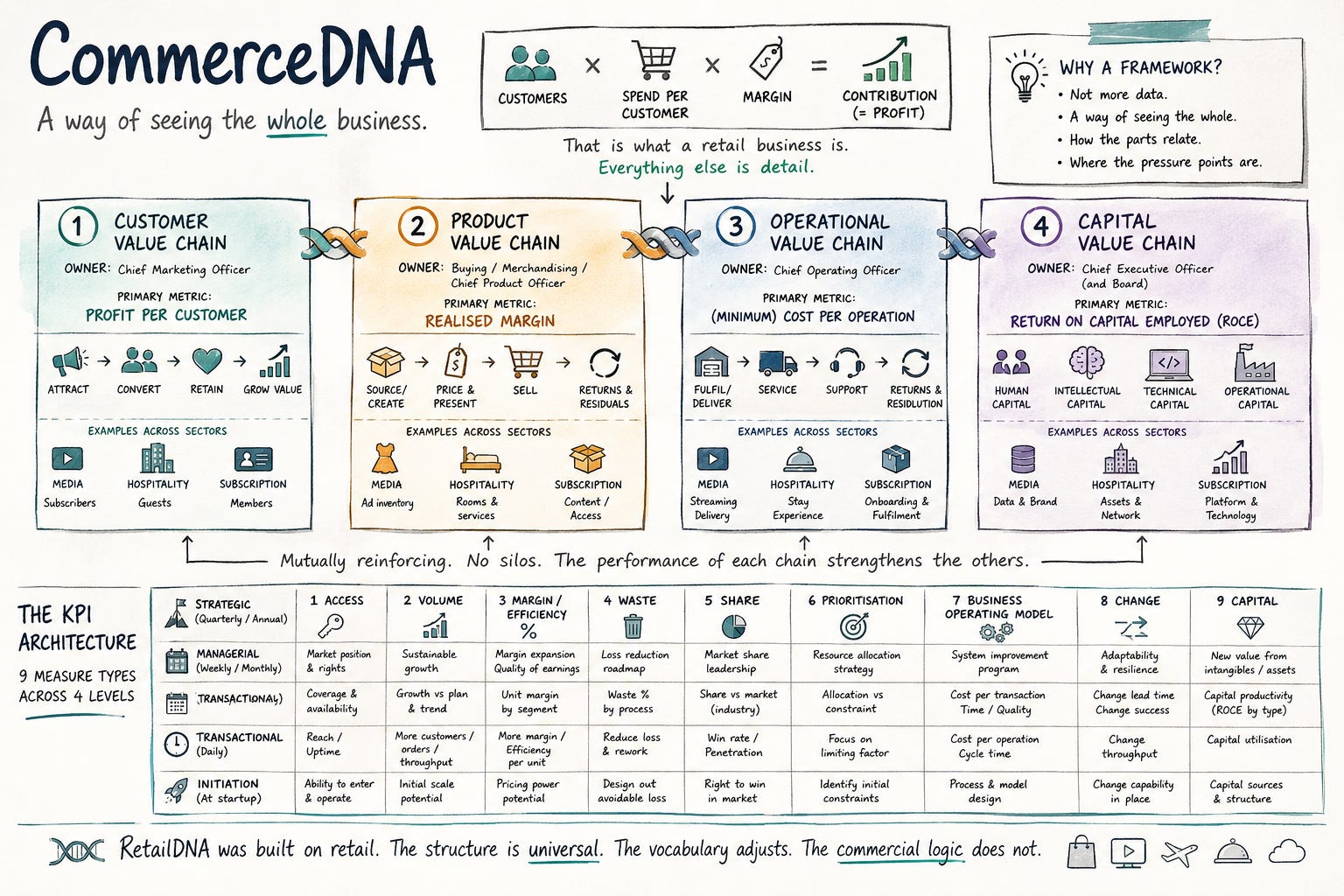
The fundamental structure
RetailDNA holds that retail performance is produced by four interwoven value chains. Not one, not two — four. Each with its own logic, its own leadership, and its own primary measure of success.
The four are:
The Customer Value Chain
The Product Value Chain
The Operational Value Chain
The Capital Value Chain
Each describes a different dimension of what a retail business actually does. Together, they explain where value comes from, how it is converted into profit, and — critically — where it leaks away.
The starting point, before any of the chains are examined, is a simple commercial identity:
Customers × spend per customer × margin = contribution
That is what a retail business is. Everything else is detail.
Customers are the volume, spend per customer comprises average order frequency, average order value (itself average items per order x average item value), while margin includes the costs of selling, the cost of the product and the operational costs per order. Whether we’re retailers selling dresses, hotels selling rooms and services, airlines selling tickets to capacity - at a high level this describes all customer-facing businesses.
Beyond the transactional level, we also need to understand what it enables us to produce - not just in direct cost terms, but in the broadest sense: financial capital, human expertise, intellectual property, technology, and operational infrastructure. All of it is capital, in the widest sense. The question is whether the contribution justifies the capital committed to produce it.
That question, held across all four value chains simultaneously, is what RetailDNA is designed to answer. We set out a board-level owner of the value chain, and a simple performance approach that works at a micro (in-team, expert) level and at the board table. Schematically we have:
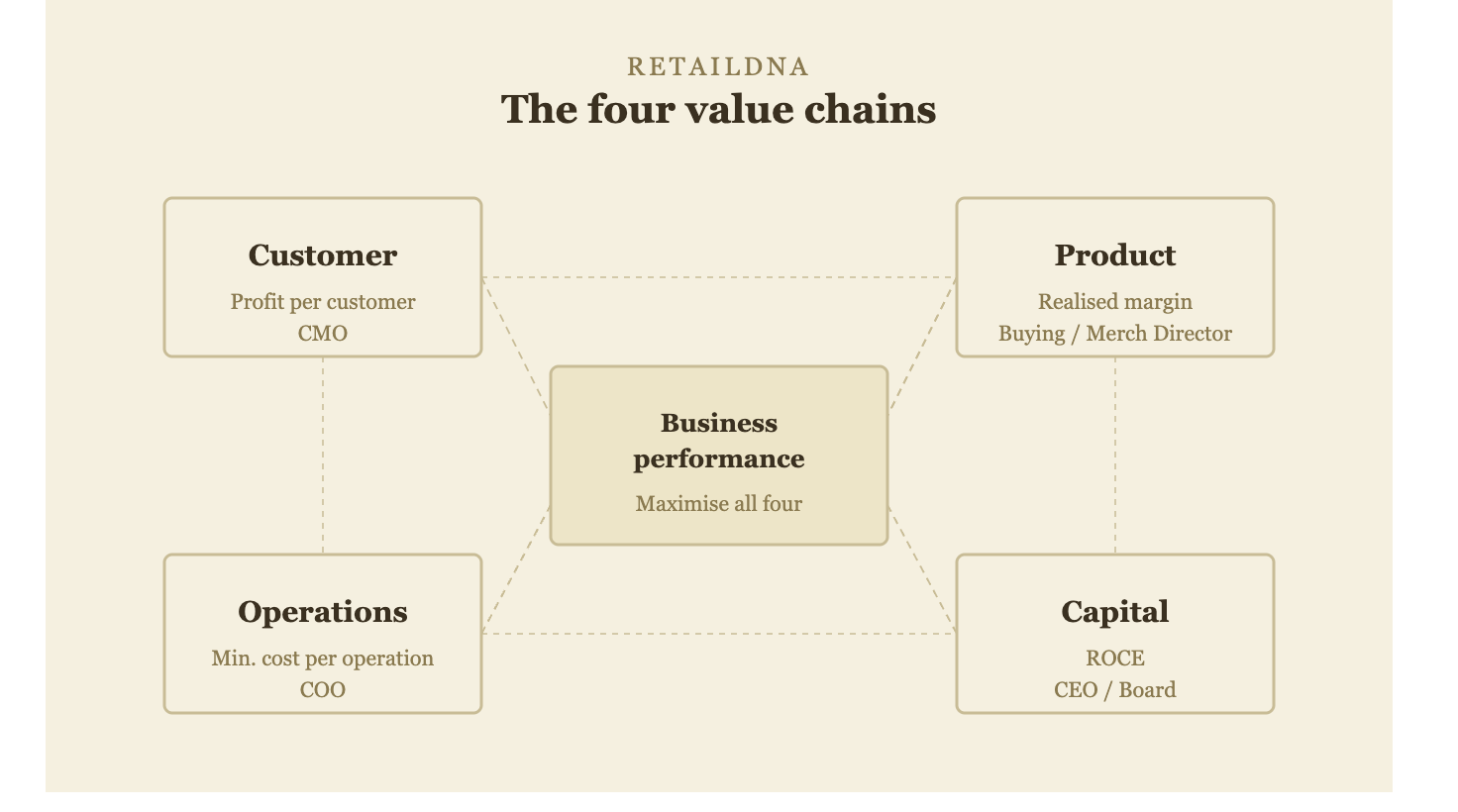
The four value chains
The value chains are applicable across all D2C sectors. Below we look at the value chains through the lens of media, hospitality and subscription businesses. The commonality is that value is maximised where a business makes the most of its customers, products, operational capabilities and its capital resources.
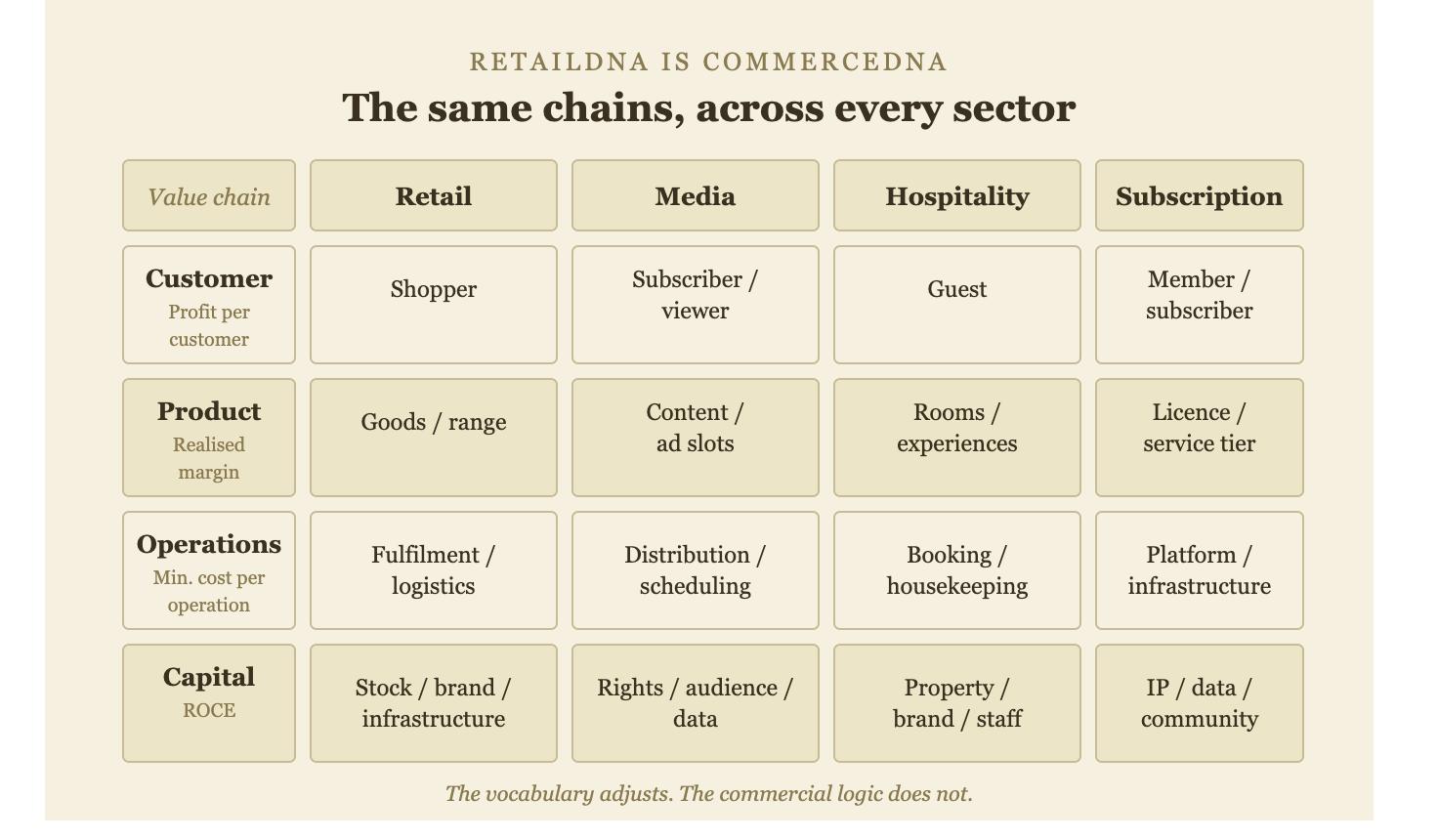
The Value chains in more detail
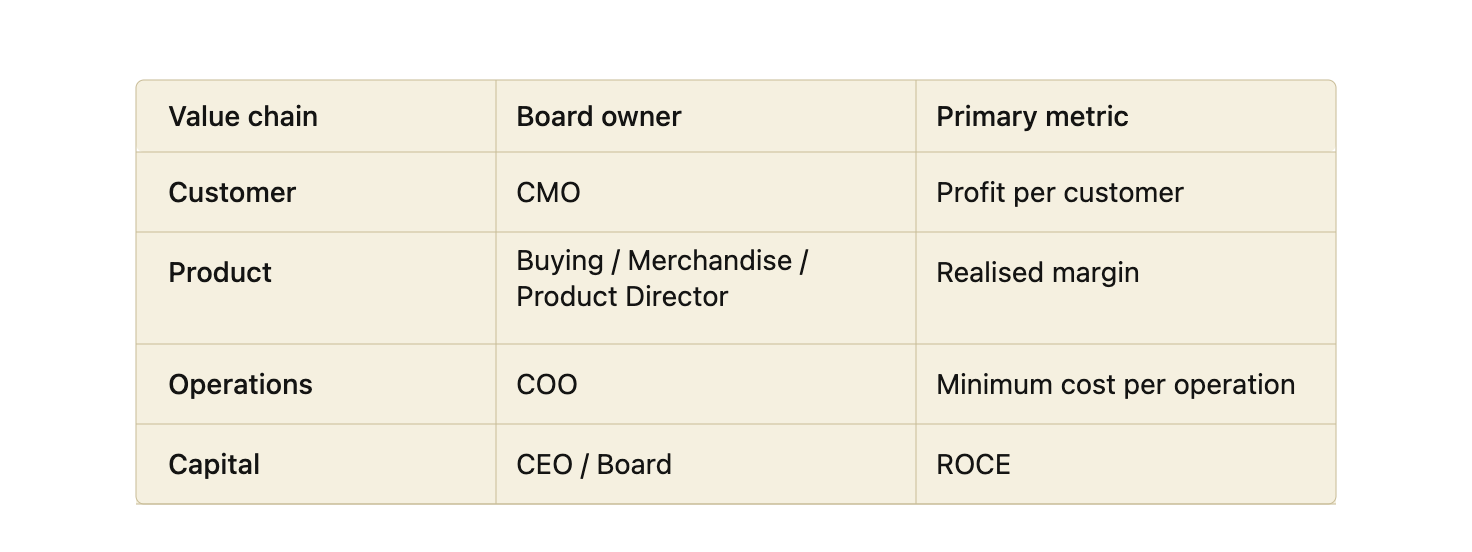
1. The Customer Value Chain
Owner: Chief Marketing Officer
Primary metric: Profit per customer
The first and most obvious value chain. Customers are the source of all commercial activity. Without them, nothing else matters.
But the objective is not simply to acquire as many customers as possible. That framing leads to expensive, low-quality growth — large numbers of customers who buy once, are costly to reach, and contribute very little. The real objective is to acquire the right customers, persuade them to spend, bring them back more often, and do so at a margin that makes the whole effort worthwhile.
This is why profit per customer is the right measure at the board level. Not traffic. Not orders. Not even revenue. Profit per customer forces the conversation to be honest about what acquisition and retention actually cost and whether the results are worth it.
The Customer Value Chain encompasses everything from initial brand awareness and first purchase through to long-term retention, reactivation, and the management of customer lifetime value. It is not a marketing chain. It is a trading chain that happens to begin with marketing.
2. The Product Value Chain
Owner: Buying Director, Merchandise Director, or Chief Product Officer
Primary metric: Realised margin
Retailers do not make money from having stock. They make money from converting products into cash at the best achievable margin, with the minimum avoidable loss along the way.
The Product Value Chain maps the life of a product from sourcing or creation, through pricing and presentation, to sale — and beyond, into returns, residuals, and disposal. Every stage either adds margin or removes it. The buying decision, the pricing architecture, the promotional strategy, the management of excess inventory: all of these are product chain decisions, and all of them affect the realised margin.
Note: realised margin, not planned margin. The difference between the two is what actually happened to the product as it moved through the business. It is a more honest number.
The Product Value Chain is generally owned by the trading function — buying, merchandising, or product — depending on the type of business. In a fashion retailer, it lives with the Buying Director. In a branded goods company, it may sit with the Chief Product Officer. The chain is the same; the language shifts.
3. The Operational Value Chain
Owner: Chief Operating Officer
Primary metric: (Minimum) cost per operation
Operations is the connective tissue of retail. It is the set of processes that link customers to products - and it has a straightforward objective: deliver the product to the customer at the quality and speed they expect, for the lowest sustainable cost.
That does not mean cutting corners. It means eliminating costs that add nothing. The Operational Value Chain covers fulfilment, logistics, warehousing, customer service, returns, technology infrastructure, and the processes that make those things work. Each of these has a cost, and each should be understood in terms of what it contributes relative to its cost.
In operational contexts — and in some non-commercial organisations — the word efficiency is more useful than margin. The intent is identical: do more with the same, or the same with less. The distinction is simply one of vocabulary, not commercial logic.
4. The Capital Value Chain
Owner: Chief Executive Officer (and board)
Primary metric: Return on Capital Employed (ROCE)
The Capital Value Chain is the one most often overlooked — not because it is unimportant, but because it operates at an abstract level that doesn’t flex at the same speed or the same way as sales and purchases.
Capital, in RetailDNA, is not only financial. It encompasses
human capital (expertise, leadership, team capability),
intellectual capital (brand, data, proprietary process, IP),
technical capital (systems and platforms), and
operational capital (the capacity, infrastructure, and relationships that enable trading).
All of these are resources that have been committed to the business. All of them should be earning a return.
ROCE is the board-level measure: is the capital deployed in this business generating an adequate return? But the Capital Value Chain is about more than the ratio. It is about understanding which forms of capital are being deployed, whether they are earning their keep, and whether the allocation of capital across the other three chains is producing the best achievable outcome.
There are crossover cases. A patented operational process is also an example of intellectual capital. A deeply loyal customer base is a form of brand capital. A proprietary logistics network is simultaneously an operational asset and a capital asset. These overlaps are real. They do not undermine the model, rather they enrich it.
How the chains relate
The four chains are not independent. They are mutually reinforcing — and that is the point.
Low operating costs support higher profit per customer.
Higher product margin directly feeds contribution.
Strong customer retention reduces the capital required to maintain revenue.
The Capital Value Chain ultimately rests on the performance of the other three.
This means that the leaders around the board table are not competing with each other. They are contributing to a shared outcome. A CMO who grows profit per customer makes the COO’s cost-per-operation numbers easier to sustain. A Buying Director who improves realised margin reduces the pressure on customer volume that the CMO needs to deliver. They are pulling together — even when it does not feel that way.
The failure mode, conversely, is sub-optimisation: each function optimising its own primary metric while the whole is less than the sum of its parts. The model is designed to prevent that by making the connections explicit.
Maximising resources at limits - working with binding constraints
Traditional approaches to value chain analysis — including Porter’s original five-chain model — tend to focus on process optimisation. Improve each step. Reduce friction. Drive efficiency throughout.
RetailDNA takes a different view: in practice, performance is determined not by the average efficiency of your processes but by how well you are performing against your current binding constraint.
The logic is sequential and commercial. If there are unlimited customers available to you, the priority is volume — get more of them. Once the accessible customer pool is effectively saturated, adding more customers yields diminishing returns. At that point, the only way to grow contribution is to extract more value from the customers you already have: increase their spend, improve their margin, extend their tenure.
The same logic applies across all four chains.
The right question at any moment is: what is the limiting factor, and are we maximising against it?
This is not a management philosophy. It is commercial arithmetic made explicit. Resources are finite; the task is to deploy them where they yield the greatest return given the current constraints.
When the constraint changes — and it will — the priority shifts. The framework accommodates this naturally, because it tracks the metrics across all four chains simultaneously rather than optimising a single lever in isolation.
The KPI architecture
RetailDNA organises performance metrics into a common architecture that applies across all four value chains. The same nine KPI types appear in every chain, expressed in the language appropriate to that chain.
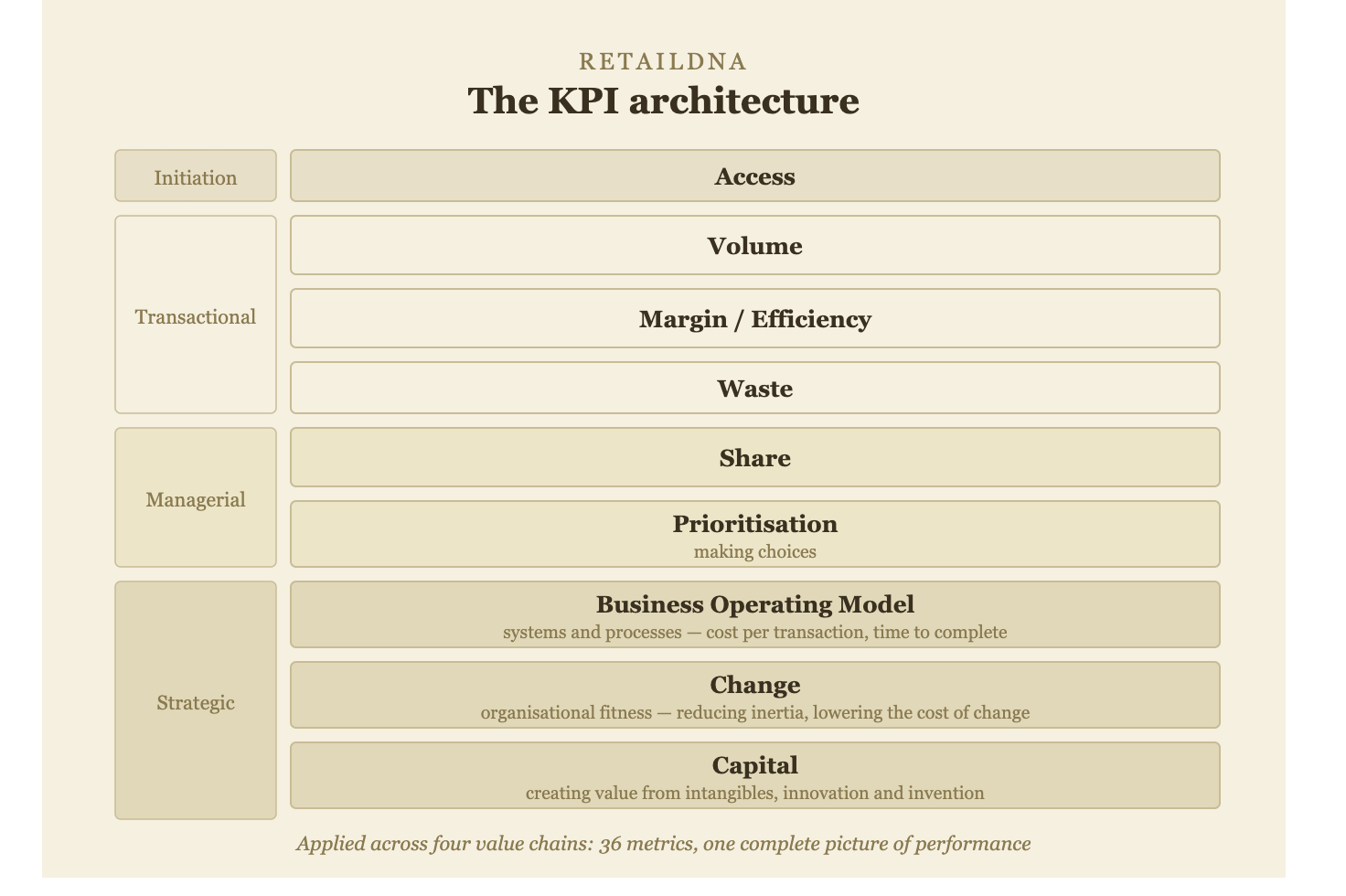
Those nine types sit across four levels, which represent the type of management or system activity, and of course frequency. Initiation and Strategic activities are periodic, while transactional and managerial are daily. These performance measures are detailed below.
Performance measures by type
Initiation (at startup or new activities)
Access — the ability to enter and operate in a market. For customers: reaching them, being allowed to sell to them, and having something they want. For product: being able to source it, license it, and make it. For operations: having the capacity, the infrastructure, and the permissions to operate. For capital: being able to access finance, talent, and intellectual rights.
Transactional (the daily focus)
Volume — more: more customers, more products, more orders, more throughput
Margin — more from each unit of volume: higher spend per customer, better achieved price, lower cost-to-serve. In operational and non-commercial contexts this is better described as efficiency, though the underlying intent is identical
Waste — elimination of avoidable loss: abandoned baskets, out-of-stocks, failed deliveries, unused data, process breakdowns
Managerial (the weekly and monthly view)
Share — external perspective: are we growing relative to the market, or just treading water in a rising tide?
Prioritisation — the allocation of constrained resources. Every business has a limiting factor at any given moment. Prioritisation is the discipline of identifying it and maximising return against it. In plain terms: making choices
Strategic (the quarterly and annual horizon)
Business Operating Model — are our underlying systems and processes improving? Cost per transaction, time to complete, quality of output
Change — are we becoming more capable of adapting? Reducing the cost and difficulty of change, building organisational fitness
Capital — are we creating new value from intangibles, from innovation, from the assets we have built? This is distinct from prioritisation, which extracts better return from existing capital; this KPI seeks to grow or create capital
Applied across four value chains, this produces thirty-six high-level performance metrics: a complete map of retail performance, from the first day of trading to long-term enterprise value creation.
The transactional metrics — volume, margin (or efficiency), and waste — are the daily engine. The managerial metrics are the monthly levers. The strategic metrics are the board’s territory.
RetailDNA is CommerceDNA
RetailDNA was built on retail. The language is retail language: customers buying products through operations funded by capital. But the underlying structure is not retail-specific.
Consider what each value chain actually describes:
Customers are whoever you are trying to serve and monetise. In retail, they are shoppers. In the media, they are subscribers, viewers, or audiences. In professional services, they are clients. In hospitality, they are guests. The chain — acquire, retain, grow value — is identical.
The product is whatever you are selling. A dress. An advertising slot. A hotel room. A streaming subscription. A software licence. A consulting engagement. In every case, there is something being offered, priced, and converted into revenue at a margin. The chain - source or create, price, sell, manage the margin - applies universally.
Operations is how you connect what you sell to the people who want it. Logistics for a retailer. Scheduling for a broadcaster. Booking and housekeeping for a hotelier. Technology infrastructure for a software business. The objective — deliver reliably at the lowest sustainable cost - does not change.
Capital is the scarce resources committed to making the whole thing work. It is always financial, human, intellectual, and operational. The question - are those resources earning an adequate return? - is universal.
This is not a coincidence. The four chains describe the fundamental structure of any commercial operation whose purpose is to serve customers through the delivery of products or services, sustainably and at a return.
RetailDNA, in other words, is CommerceDNA.
This matters practically. The events and research I work on through RetailX now encompass retail media, connected television, FMCG brands, direct-to-consumer commerce, and AI-enabled trading — each operating under the CustomerX umbrella. The CommerceAI agenda maps directly to the four chains: the AI-empowered customer, AI to attract and convert, AI for operational efficiency, AI for enterprise value creation. The framework did not need to change to accommodate these sectors. It already described them.
The vocabulary adjusts. The commercial logic does not.
If you are a retailer, RetailDNA gives you a complete language for your business. If you are a media owner, a brand, a marketplace, or a platform, CommerceDNA gives you the same language — because you are running the same underlying machine.
In summary
RetailDNA is a 9-measure performance framework that is consistent across the four value chains in retail. The whole is greater than the sum of the parts. While developed 20 years ago to manage the disruption of ecommerce and digital retail on the D2C sector, our recent moves via Retail and Commerce Media into Grocery, CTV and travel, plus our plans for leisure, hospitality, finservs, health etc with CustomerX, have shown that it applies across all consumer-facing sectors.
If you’d like to challenge, improve or question the CommerceDNA framework then do drop me a line. Let me know too whether any parts resonate with you.
RetailDNA is the underlying performance structure developed to measure and understand retail and commercial performance. It is used across RetailX research, events, and analysis. Ian Jindal is the Founder of RetailX and CustomerX (www.retailx.net and www.customerx.net).