


TL;DR
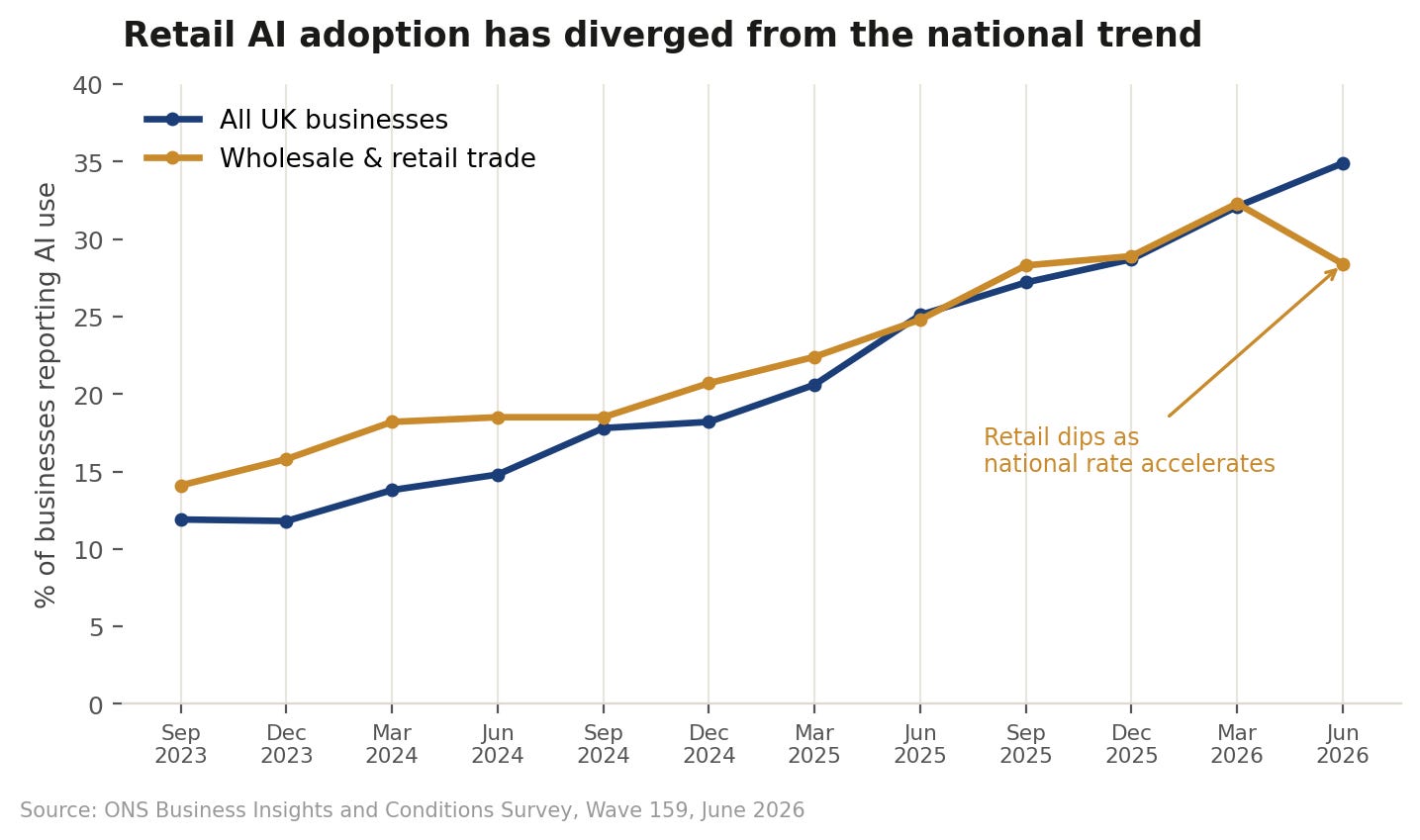
AI use among UK businesses has almost tripled since late 2023. But beneath that encouraging headline, retail’s adoption looks broad, shallow and uneven.
In this article:
AI use is rising fast, although most businesses still use relatively few technologies.
Borrowed, not built: Retailers rely heavily on free or purchased tools.
Easy wins first: AI is advancing fastest in content and creative—not pricing, inventory, supply chain or commercial optimisation.
The leadership “shear”: Leaders, teams and boards show sharply different levels of enthusiasm, readiness and resistance.
The value gap: AI is helping individuals more than teams, and teams more than the business as a whole.
The strategic question: Can retailers align these organisational layers before their different speeds pull the ‘capability tower’ apart?
ONS report on AI adoption
The UK’s Office for National Statistics (ONS) today released its latest research on business AI adoption of AI. Drawn from its regular Business Insights and Conditions Survey, it plots the changes over time from 2023 to now.
The headline finding is positive, but the retail sector information holds another story.
Headline: AI use among UK businesses has almost tripled since late 2023, from around 12% to around 35%.

Summary of the report
You can read the very digestible report here on the ONS site, but the headlines are:
UK business AI use has almost tripled since late 2023, from around 12% to around 35%, though adoption remains shallow; the average number of technologies used per business has only risen from 1.4 to 1.6.
Sector variations: Adoption varies sharply by sector (58% in information and communication vs 13% in construction) and by size (49% of businesses with 250+ staff vs 28% of the smallest).
Employees vs their own businesses: Employees report using AI more than businesses do (55% vs. 35%), suggesting individual use is outpacing formal adoption.
Purpose and impacts: Improving business operations is the top reported use (nearly 60% of larger businesses), ahead of personalising products or exploring new markets. Most businesses adopt via free-to-use software or purchased tools rather than building in-house.
Employment impact: around half of businesses report no change to workforce headcount so far. Where impacts are reported, they land hardest on creative/design and administrative/clerical roles, not customer-facing ones.
Barriers to adoption: 41% of businesses report no barriers at all. Where barriers exist, lack of expertise and cost are the most cited, and businesses facing an expertise gap are far more likely to respond by training existing staff (62%) than by hiring or automating.
Behind the headlines - the retail sector
ONS makes the full dataset available1 so you can set your AI to work on it. I reviewed the sector splits (where ‘retail’ is in their category called “Wholesale and retail trade; repair of motor vehicles and motorcycles”), and overlaid information from the ongoing RetailX Leadership Barometer on AI attitudes, and we can see that retail’s adoption and outlook is not the same as the headline suggests.
Three themes emerge (the grouping is mine), namely:
retail is borrowing/renting AI capability rather than building it, with a focus on the lowest-stakes element of business activity and value;
the leaders, teams and boards are reacting to the technology in very different ways, and
confidence in the business’ position and outlook drops as you move further from a leader’s own desk…
The Leadership Barometer is ongoing; please take 12 minutes to share your views. All who complete the survey will get access to the data cube so you can discuss in your own AI, as well as to our attitudinal archetypes.
1. Retailers are users of AI, not creators of it, and it shows in where they use it
Among retail businesses using AI, 53.6% rely on free-to-use software. Only 5.9% have developed anything in-house. Just 3.4% have outsourced AI work to a third party. This compares poorly with the (obvious) lead adopter, Information and communication businesses, who develop AI in-house at nearly five times the rate of retail (28.5% vs. 5.9%). Professional, scientific and technical services do it at more than double the rate (14.5%). Even manufacturing out-builds retail by a similar margin (14.9%).
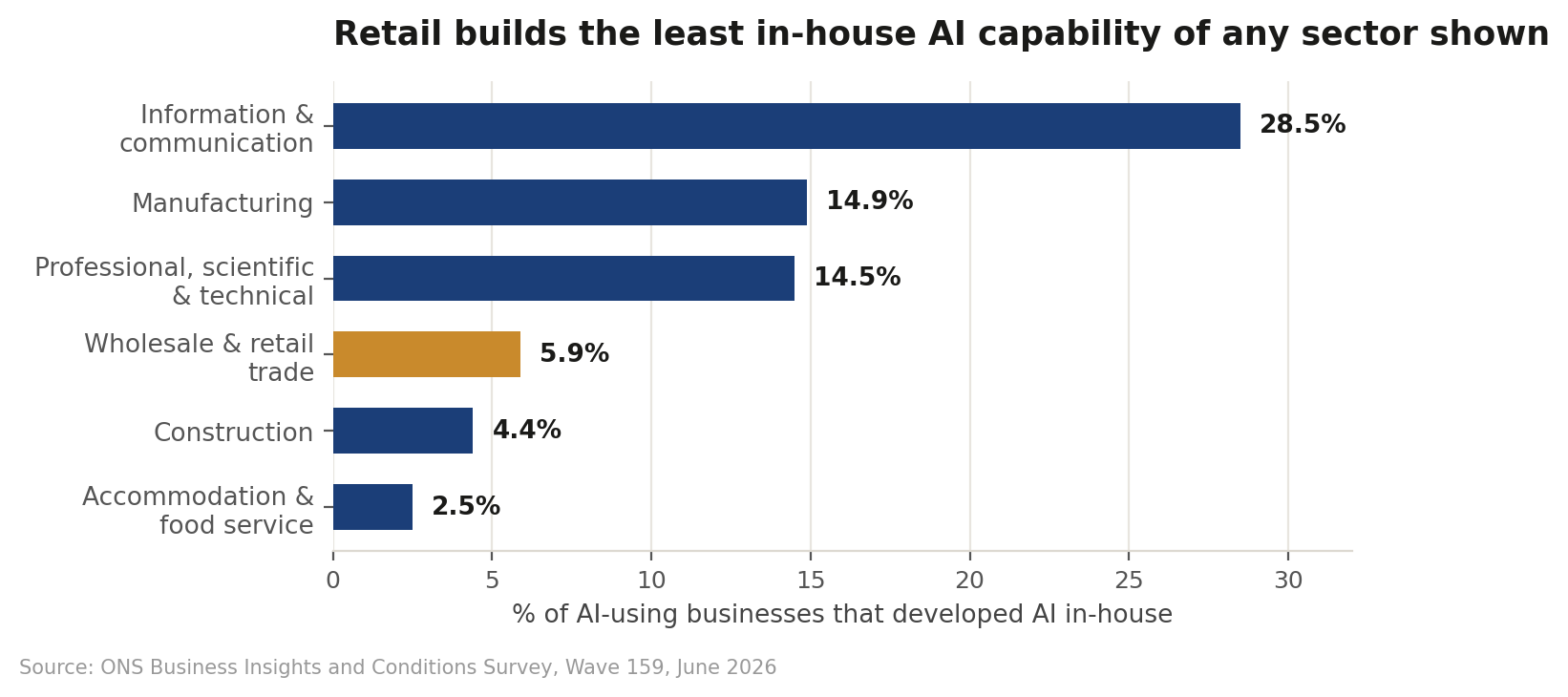
Now, it’s much easier to use AI to improve or act upon “non-physical” material. A research report, data, software, report - these are all easier to wrangle than a warehouse full of stock, or handling a return and refund. So, there are valid reasons why broad retail may not have the same adoption as the ‘digital brainpower’ and virtual product folk.
The investment figures tell a similar story. Among retailers already using AI, 42.6% have made no financial investment in it. Another 30.8% have spent less than £10,000.
Now, some of this will be because the most-used AI is baked into existing software investments - whether Gemini or Copilot with office workspace offerings, or the AI built into every existing system. Furthermore, Retail was an early-adopting sector.
So these figures could mean that retail leaders are being canny and exploiting their existing tools. Or it could indicate that the ROI case is not clear in the complex world of multichannel. For insight, we can look at some interim data from the RetailX Leadership Barometer’s attitudinal survey.
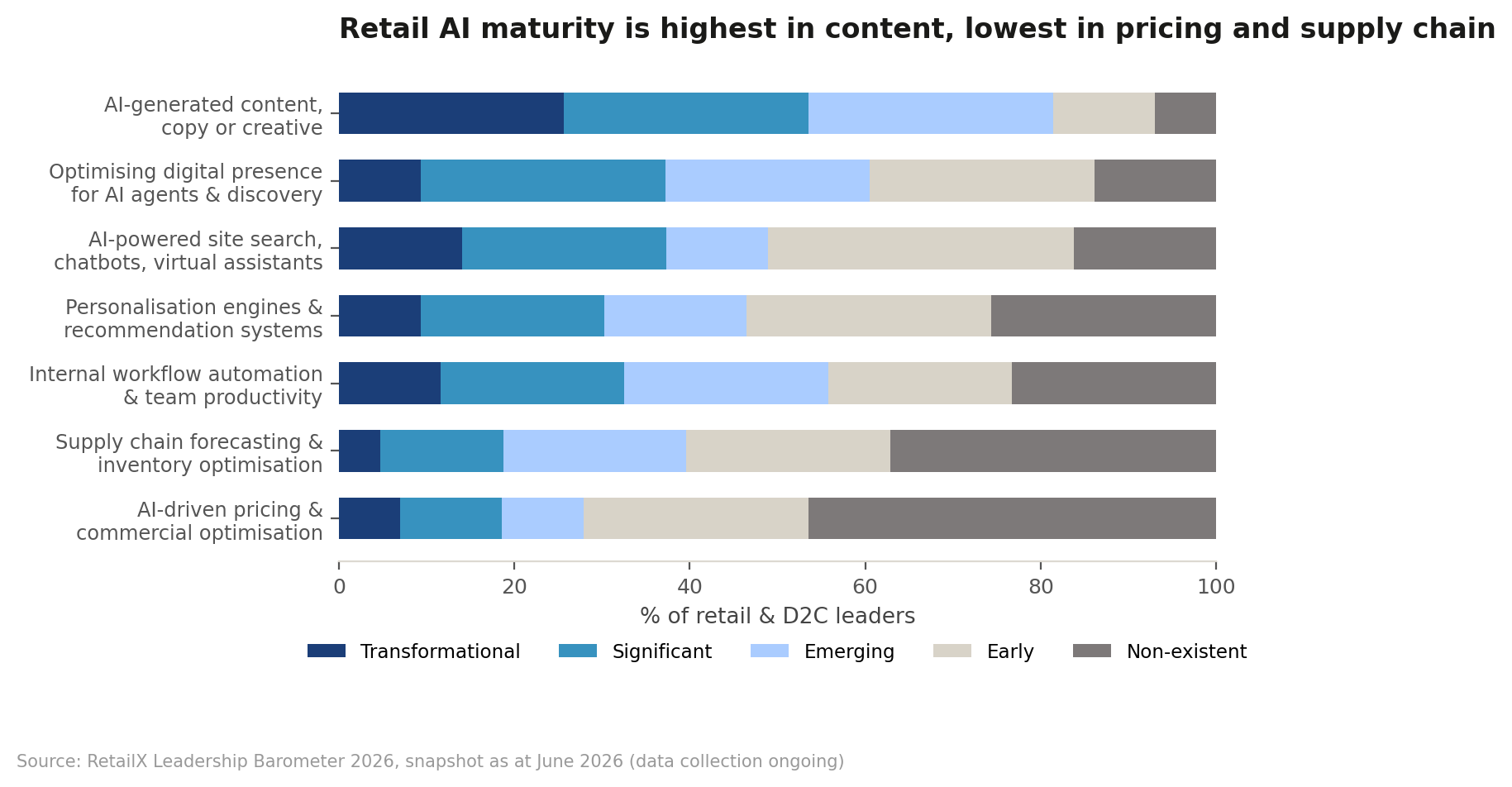
RetailX’s own Leadership Barometer shows exactly where that unbuilt, unfunded activity is landing. Asked to rate AI maturity across ten operational areas, retail and D2C leaders report AI-generated content and creative as the most advanced use case by a wide margin: only 7% say it’s non-existent in their business, and over half describe it as transformational or already in production at scale. Compare that with AI-driven pricing and commercial optimisation, non-existent in 46.5% of businesses, or supply chain forecasting and inventory optimisation, non-existent in 37.2%.
This reinforces the observation above that rapid change in the digital and “non-physical” areas is simpler to undertake. Changing infrastructure, ERP and WMS is a non-trivial, complex undertaking.
Retail’s AI activity is heaviest exactly where it’s cheapest to pick up and easiest to walk away from. While there are benefits to cost and revenue, these are likely to be less than transformational. Equally the focus on copy and content is the easiest area for competitors to copy, and for customer-side AI to cut through.
2. Different views: Three layers, three different views of the same technology
RetailX’s Leadership Barometer asked retail leaders to rate AI sentiment, resistance and skills readiness for themselves, their team, and their board. The response hints at a ‘shearing effect’, where layers of the business are operating at different speeds (where that difference is a negative factor).
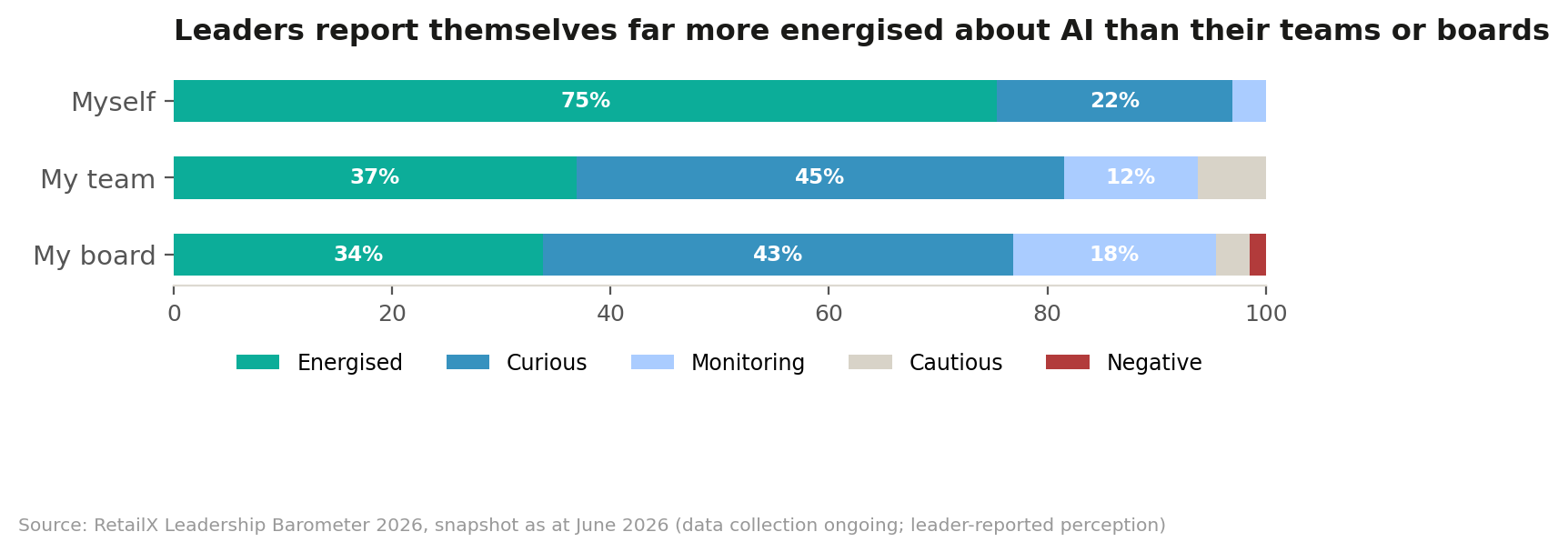
On sentiment, 75.4% of leaders describe themselves as energised about AI adoption. For their own teams, that figure drops to 36.9%. For their boards, it’s 33.8%, with board responses the only ones to register any negative sentiment at all (1.5%).
On resistance, the pattern runs the same direction. 55.4% of leaders say they personally feel no resistance to AI at all. That drops to 26.2% when they’re describing their team, and 27.7% describing their board. Asked about their wider industry, only 9.2% see no resistance whatsoever.
On skills, the gap is sharpest at board level. 64.5% of leaders say they’re personally on track to acquire the AI skills they need. For their team, that falls to 46.8%. For their board, only 30.6% are judged on track, and 51.6% may not acquire the necessary skills in time.
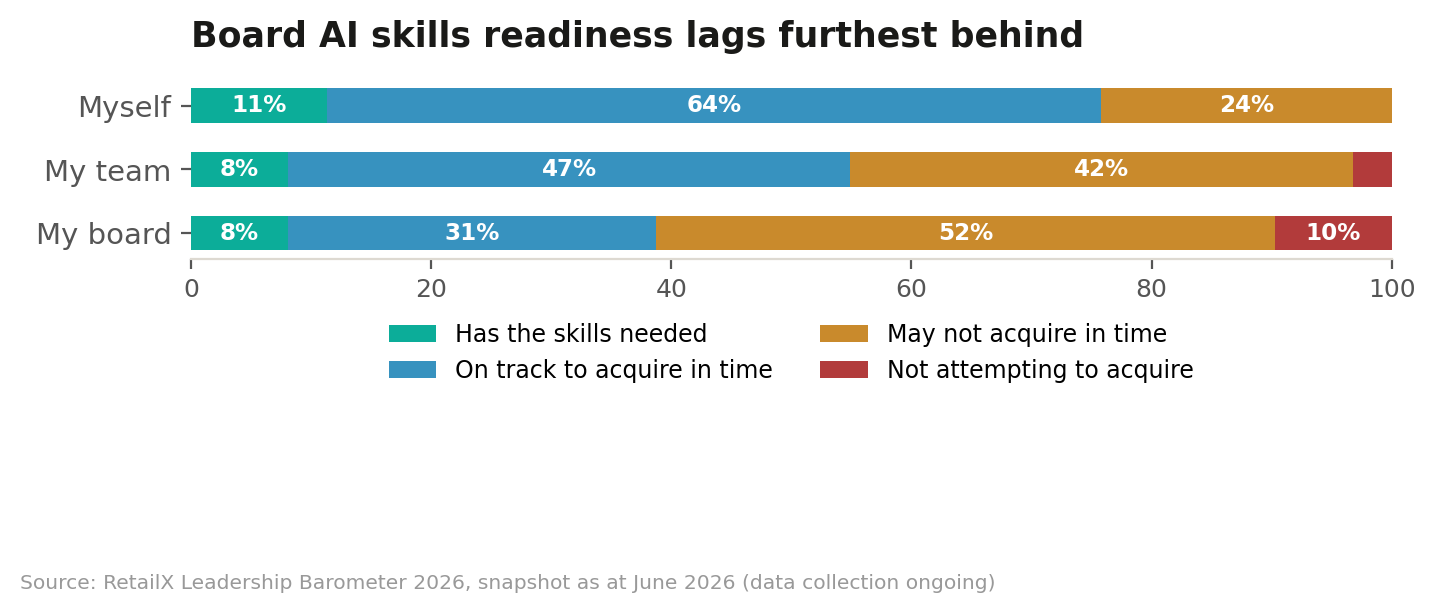
This is an attitudinal survey: leaders reporting their own perception of their team and board. Self-reported comparisons like this tend to flatter the person doing the reporting, so this is indicative rather than definitive. However, there is consistency across three separate questions, all narrowing in the same order (self, then team, then board) that is directionally important.
It also mirrors the national ONS pattern, where 55% of employees report using AI for work against 35% of businesses formally adopting it.
Individuals are ahead of the organisations around them, and in retail’s case that gap appears to widen again as you move up towards the board.
3. Where satisfaction actually breaks down
The hard-nosed question is whether AI is delivering value: to the leader, their team and their business.
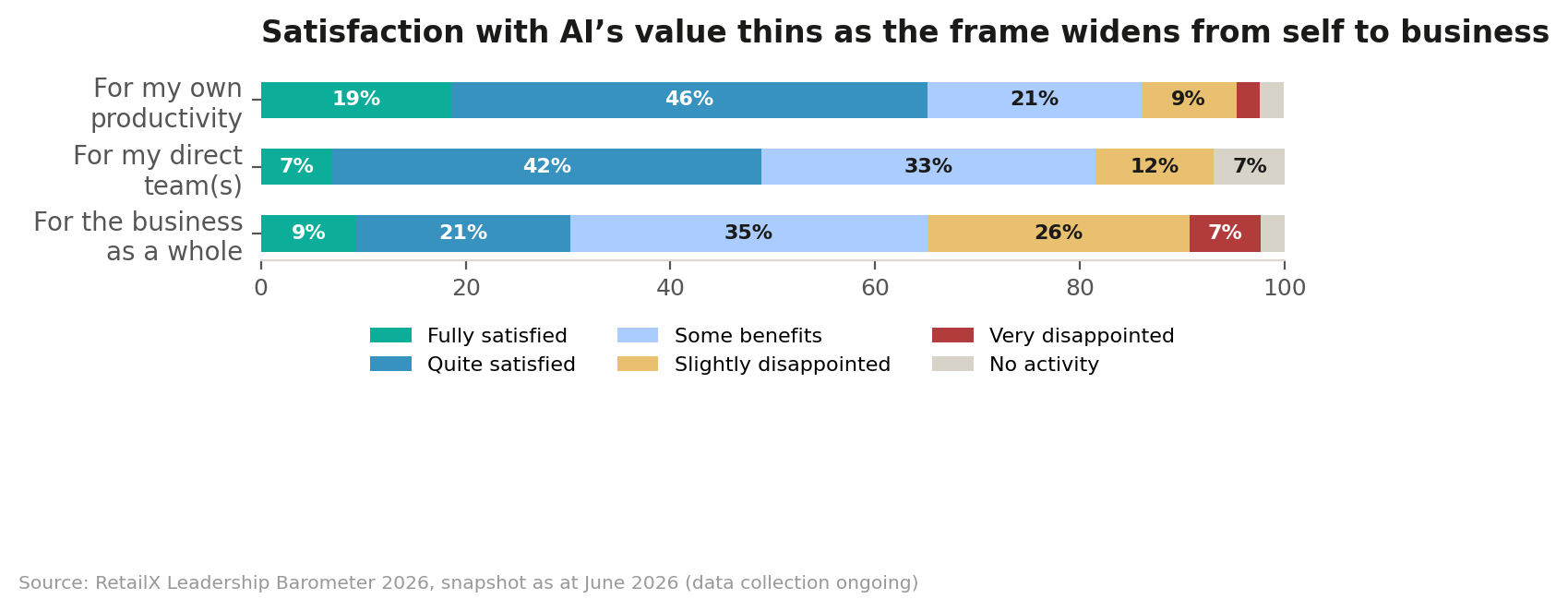
Asked how satisfied they are that AI is delivering value, 65.1% of leaders are fully or quite satisfied with what it’s doing for their own productivity. For their direct team, that falls to 48.9%. For the business as a whole, it falls again to 30.2%, and the “slightly” or “very disappointed” responses roughly triple over the same span, from 11.6% at the personal level to 32.6% at the business level.
This reflects the personal adoption of AI as a productivity tool, but a strategic gap in seeing deployment (and therefore value) across the business.
So, another ‘shearing’ force is that ‘getting better at my job’ is not translating to ‘our business becoming more capable and competitive’. This leadership disconnect will pull at the coherence between people skills and organisational capability. The whole is not greater than the sum of the parts.
There’s much more to come from the Leadership Barometer, but that’s for another post (reminder: have you contributed to the research? Hint → take the survey please)
Interpreting the signals
The lower adoption of AI by retailers is a leadership and competitive question.
Retailers are savvy, and after 20 years of digital investment, they are taking the easy wins (content and already-digital areas of the business) while seeking ROI in other areas. Furthermore, they benefit from the AI capabilities built into all systems (a rising tide floats all boats).
The underlying question in 2026 is that of leadership ‘shear’ - the forces that can pull apart the retail ‘capability tower’ as the layers move separately against each other.
Retail has adopted AI widely but shallowly, in the parts of the business that are cheapest to touch and easiest to reverse. Its people are more confident than its teams, its teams more confident than its boards, and satisfaction with what AI is actually delivering thins with every step away from the individual desk.
Next
There’s no debate as to whether retail will adopt more AI. It almost certainly will, and the Barometer suggests leaders expect it: 70% agree or strongly agree that AI will fundamentally change their business model within five years, while only 10% currently rate their business model as fit for that era today.
The leadership question is whether the layers in the organisation can consolidate and cement leaders' views, adoption, and approach before the shearing forces make AI exploitation more challenging and less effective.
Critically, we need to find ways for the AI capabilities currently concentrated in content and marketing to extend into pricing, supply chain and commercial systems too.
What do you think?
Please give us your own views on AI adoption - either message me if you’d like to chat off the record, or share your insights in a comment/note. Best of all would be to complete the Leadership Barometer so that we can complete the survey and create the “digital twins”. As I mentioned in my note on the ‘archetypes’ in the survey, we will share the data cube with all respondents.
Endmatter
We provide a forum to discuss the value chains and AI adoption in our CommerceAI event. The inaugural CommerceAI Think Tank was in June, 2026, and we’ll be running another session during CustomerX on 14 and 15 October, 2026 (registration here).
Sources: ONS Business Insights and Conditions Survey, Wave 159, 5 June to 28 June 2026, “Artificial intelligence in UK businesses: 2023 to 2026,” released 20 July 2026.
RetailX Leadership Barometer 2026, pre-completion extract of data, June 2026.
The download data and historic comparisons are available from ONS here: https://www.ons.gov.uk/economy/economicoutputandproductivity/output/datasets/businessinsightsandimpactontheukeconomy