


When I wrote recently that AI is accelerating the move to a post-sector world, I was trying to describe a commercial reality that is already in plain sight.
Customers do not live in sectors.
They do not wake up and decide to spend the day in “retail”, “travel”, “media”, “finance” or “hospitality”. They live in situations, occasions and needs. They aggregate services, products and experiences according to context. Yet most businesses still think in their own vertical, optimising an imaginary funnel and hoping to squeeze the customer into a sale.
Each seller now lives alongside other players, able to watch them and be seen by them, as they each try to maximise their share of the customer’s finite disposable and discretionary spend.
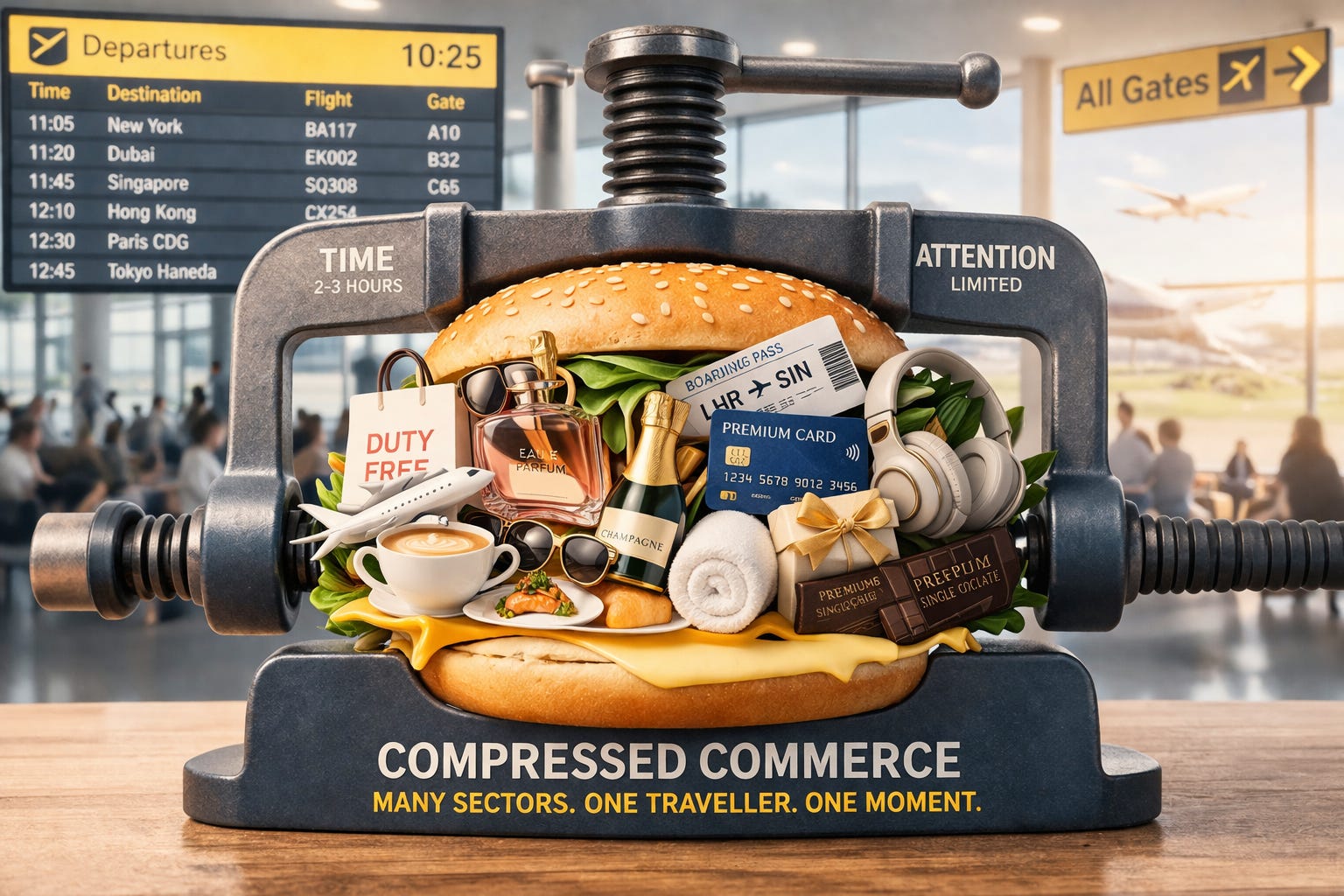
In this short series, I want to explore some of these customer contexts: the settings in which the post-sector world is easiest to see. This article starts with one of the clearest examples: the airport. ✈️
Subsequent pieces will look at: the sofa and the Friday-night economy; body data and wearables; belonging and the membership economy; and peace of mind, where insurance, pensions, investments and savings all end up selling some version of hope.
To the airport…
For now, though, let’s head to our favourite international airport. Heathrow Terminal 5, perhaps. Singapore Changi. Doha Hamad. Hong Kong. Charles de Gaulle. Tokyo Haneda. The better ones are no longer merely places of pre-flight confinement - a shopping mall with security and duty free. They are places that make being trapped for a couple of hours feel almost aspirational: Michelin-starred food, spas, lounges, luxury retail, media, wellness, and enough polished surfaces to reassure you that travel is still glamorous, even if you are heading for 44B in economy.
Each sector can point to its own presence there and say, “we have a store”, “we have a lounge”, “we have a restaurant”, “we have a partnership”. Fair enough. But there is now a context or commercial modality greater than the sum of its selling parts.
The compressed economy
The airport is no longer just a transport interchange with shops attached. It is a dense, intense commercial environment in which travel, transportation, mall, luxury, restauration, media, payments, hospitality and tourism converge around one traveller in one bounded period of time.
The airport, in other words, is a compressed economy.
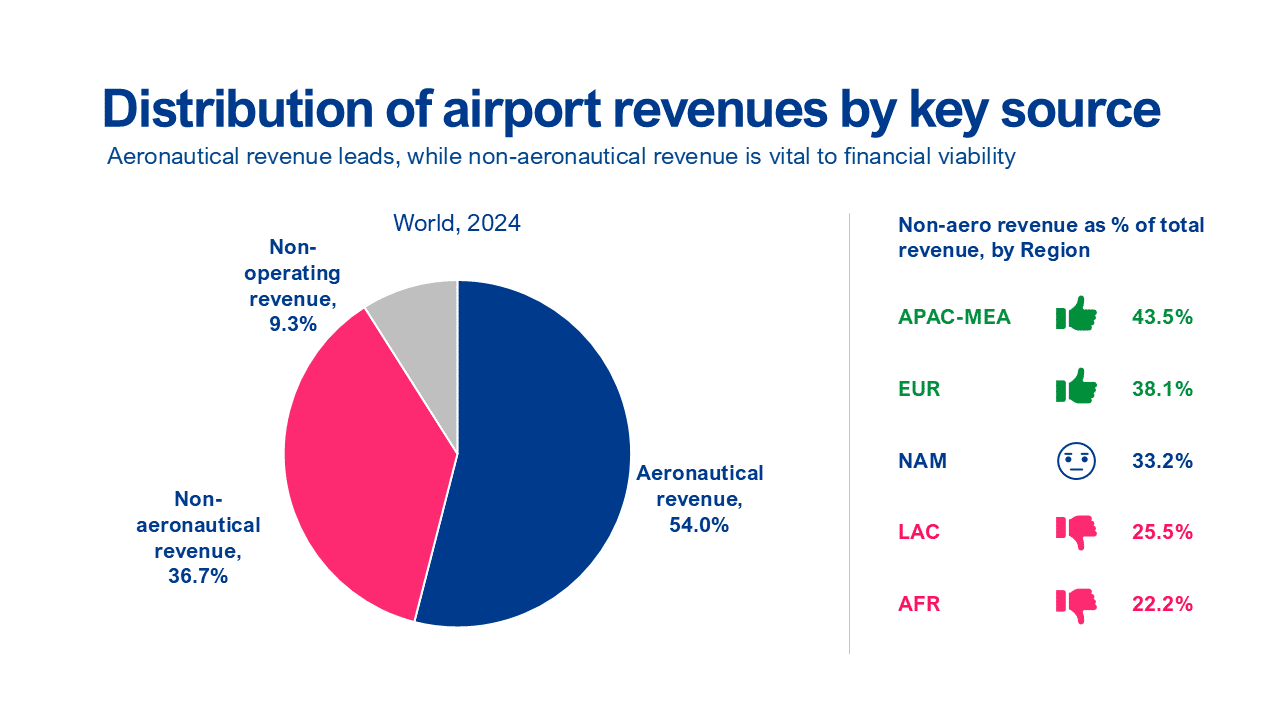
According to ACI World (ie Airports Council International), non-aeronautical revenues (great phrase!) accounted for 37% of total airport revenues in 2024 and offset 48% of total airport costs. Retail concessions remain the biggest source of non-aeronautical revenue in most regions. Commerce is not decorative here; it is structural to the business model for these posh sheds.
Avolta, one of the largest operators in travel retail and F&B, discusses the airport’s more “predictable dwell-time” between arrival and boarding. That is a deceptively important phrase. Time becomes inventory. It can be programmed, sold against, and designed around.
In fact, time is the limiting factor against which almost every player in the airport must optimise.
The customer is not merely captive. They are often receptive. J C Decaux cites1 Ipsos research showing that 70% of flyers enjoy looking at exhibition stands, shops, advertising and other things to see at the airport. Yes, of course they would say that, but the underlying point still stands: the airport is not just a retail venue. It is also a premium media environment.
Within that environment, behaviour matters as much as volume. ACI Asia-Pacific & Middle East said earlier this year that airport retail performance is increasingly shaped by “passenger behaviour, rather than sheer traffic volumes”, with younger travellers now driving spend and impulse remaining a major factor.
The value lies not simply in traffic, but in the quality and context of the engagement.
What makes the airport different
Yes. Planes, security. I know. But beyond the obvious, the airport experience starts before the passenger even reaches the terminal: booking, ancillaries, parking, insurance, lounge access, app engagement.
It continues in the terminal itself: duty free, luxury, food, pharmacy, gifting, sampling, media, payments, loyalty capture.
It stretches into transit: content, advertising, destination inspiration.
And it completes on arrival: hotels, transfers, roaming, attractions, local services.
Seen that way, the airport is not one market. It is not even merely a collection of sectors. It is a stack of adjacent sectors sharing the same person’s attention in a compressed slice of time, space and intent.
And what of the customer?
Globally, airport traffic reached more than 9.4 billion passenger journeys in 2024, with the top 20 airports alone handling 1.54 billion passengers, according to ACI’s World Airport Traffic Dataset 2025. These are passenger movements, not unique individuals.
In the UK, the CAA says there were 295 million passenger journeys through UK airports in 2024, rising to 302 million in 2025.
At Heathrow specifically2, the airport handled 83.9 million passengers in 2024 and 84.5 million in 2025.
These are vast audiences. But the real opportunity is not just volume. It is information density.
The airline knows who you are, where you are going, where you have come from, what fare you bought, what seat you are in, how much baggage you have, and often much more besides.
The airport may know your parking, lounge, Wi-Fi, app, Reserve & Collect, Fast Track or loyalty behaviour.
The retailer may scan your boarding pass and know your destination, flight timing and purchase.
The card issuer may know your spend and lounge entitlements.
The border authorities know rather a lot too 👮🏽
In other words: the airport customer is one of the most context-rich customers in commerce. Time-bound, destination-linked, identity-bearing, and surrounded by measurable behaviour.
And yet no one owns the whole picture.
The opportunity is immense, but the data remains fragmented. Airlines, airports, concessionaires, lounge operators, payment providers and governments all hold pieces of the customer record. The routes to sharing are not straightforward, legally or technically. But the commercial promise is obvious: if you can connect enough of the signals in time, you can do much more than sell a Toblerone or an overpriced bowl of noodles. You can understand the traveller’s state and shape the offer around it.
That, in the end, is the data opportunity.
Not simply “more CRM”, but a much richer ability to understand a customer who is identified, time-constrained, geographically situated, and unusually open to influence.
The existing players are not naive - they know how to optimise their ads, inventory, processes, location. However, in order to grow further they will need to work cross-sector.
New operating models in the compressed economy
This is where the airport gets interesting beyond the usual luxury-brand popup fare.
The more important story is not simply that alcohol brands build glossy stands and hand out samples3. It is that airports are becoming laboratories for cross-sector operating models.
Finance becomes hospitality
Look at lounges. These are no longer just airline amenities. They are increasingly wrapped into premium cards, memberships and paid-access programmes.
The result is that airport dwell time is being monetised not just through travel or retail, but through financial-services architecture. Lounge access becomes part of the value proposition of the card. The lounge itself becomes a physical manifestation of finance, status and hospitality.
Amex’s Centurion Lounges are the most obvious example. JP Morgan Chase has co-developed the Chase Sapphire Lounge with Airport Dimensions. Priority Pass sits across multiple card products and programmes.
The lounge becomes a club, workspace and hospitality product
The lounge itself is evolving. It is now part leisure space, part dining room, part workspace, part spa, part members’ club.
According to Airport Dimensions research, 51% of affluent travellers are heavy users of lounges. That helps explain why these environments are becoming less like waiting rooms and more like premium hybrid spaces.
Lounges offer a prototype for how hospitality, work, status and convenience can fuse together.
Wellness becomes traveller recovery
Wellness is another growing category, but the interesting point is not “airport spa exists”. It is that airports are increasingly monetising traveller recovery.
Luxury lounges have long offered showers and treatments. But the more recent direction is broader: decompression, calm, grooming, sleep, relaxation, recovery from travel stress.
Kyra Lounge opened another design-led, calm-focused space at Hong Kong International Airport this year. Be Relax has been redesigning its concepts in Dubai. Lima airport now offers sleep and relaxation pods.
The more useful way to think about this is that the airport is beginning to sell states of being: rested, reset, showered, fed, entertained, reassured.
That is a much more interesting model than the old “massage kiosk by Gate 17”.
Sleep becomes a product category
This is perhaps the clearest sign that the airport is no longer just about retail. Rest itself has become a monetisable inventory.
Sleep pods, sleep stations, quiet spaces and decompression lounges all point in the same direction: airports are learning to sell not just products, but human states.
That is a very post-sector idea. Hospitality, wellness, real estate and retail all meet in the same proposition.
The airport becomes a platform, not just a mall
And yes, there are still activations. Plenty of them. Hennessy at Changi. Johnnie Walker at CDG. Endless efforts to recreate luxury-boutique glamour under fluorescent lighting.
Some of this still feels like Blade Runner meets the mall.
But even here, the direction of travel is revealing. The activations are bigger, more immersive, more collaborative, more media-rich, and more explicitly designed around gifting, exclusivity, and premium discovery.
So while I find the pop-up story slightly less interesting than the operating-model story, it still tells us something: the airport is shifting from a place where brands rent space to a place where they try to build context-specific experiences.
Directions of travel
Several clear directions are visible here.
New launches and activations. Airports are increasingly being used to debut exclusives, channel-specific editions and occasion-led propositions, not just to distribute standard SKUs.
New partnerships. The operating model is nearly always collaborative: brand owner, airport, travel retailer, media layer, service provider, loyalty or finance partner. Airports are experimentation machines.
Premiumisation. The language of airport commerce is immersive, exclusive, ritualised and giftable. The airport compresses premium intent and still trades heavily on the glamour of travel, despite the seat map telling a different story.
Media-commerce convergence. Display, storytelling, sampling, staff interaction, digital engagement and transaction are increasingly fused together. That feels less like “retail in travel” and more like a live prototype of where commerce itself is heading.
What this means for CustomerX
Taken together — the commercial intent, the customer context, the cross-sector melting pot, the collaborations, the data density — airport commerce is one of the best examples of the CustomerX opportunity and reality.
At CustomerX, this is exactly the kind of setting we want to explore: not a sector talking to itself, but multiple leaders from multiple sectors trying to understand the same customer context.
There is much to ponder and learn. We can:
Copy how airports monetise dwell time, premium attention, and compressed decision-making.
Collaborate across travel, retail, hospitality, media, loyalty and payments, because airports show how much value is created between sectors rather than solely within them.
Compete with a wider field in mind, because your next competitor may not come from your category at all. It may simply be the adjacent player who understands the customer moment better than you do.
After all, everyone is seeking the largest and most profitable share of the customer’s finite disposable income.
So what does the airport reveal?
The airport is still a transport hub, of course.
But it is also a mall, a media platform, a hospitality environment, a loyalty engine, a data opportunity and a tourism gateway.
More importantly, it is one of the clearest real-world examples we have of a compressed economy: a place where multiple sectors converge around the same person, in the same hour, with the same commercial ambition.
It is a crucible of invention; of cross-sector activity that focuses on the customer’s context. That is why it’s included in the CustomerX conversation.
Endmatter
What are your experiences of airport cross-sector successes and failures? Do share.
If you have created something surprising, elegant or commercially potent in this space, and I have missed it, please tell me.
CustomerX takes place in London at Olympia International Conference Centre on 14–15 October 2026. I am looking for speakers, case studies and change-making idea-generators, so do get in touch.
You may also enjoy the previous piece, which argues that AI’s adoption dissolves sectors and accelerates change.
AI: solvent and accelerant on the route to a CustomerX world

For decades, commerce has been organised around sectors: retail, travel, media, leisure, finance, health. The origin of these sectors was simply that the products and services were constructed, produced and delivered differently: fresh produce to a store (Grocer), versus renting of clean and tidy rooms (hotels) or operating a current account such that c…
Coming next in the series:
The sofa — the new Friday night
Body data — wearables powering business in sport, leisure, health, insurance and socialising
Belonging — hotels, gyms, travel, cinemas, retailers, restaurants and brands in the membership economy
Peace of mind — insurance, pensions, savings and investments, where hope itself becomes sellable
Thanks for reading. Subscribe if this kind of thinking is useful to you, or share it.
Reminder: CustomerX is an event and discussion for leaders with commercial intent to meet with peers across sectors, looking to copy, collaborate, or compete to maximise their share of the customer’s disposable and discretionary spend.
Source: https://www.jcdecaux.com/blog/first-class-advertising-the-enduring-magic-of-airports
Source: Heathrow’s investor information, PDF here: https://www.heathrow.com/content/dam/heathrow/web/common/documents/company/investor/reports-and-presentations/financial-results/2025/Heathrow_%28SP%29_Limited_FY_2025.pdf
Great example of an activation here: https://moodiedavittreport.com/hennessy-fires-up-asia-pacific-travel-retail-with-lunar-new-year-campaign/
I fully agree we are moving to a post-sector world, but how do you see the new categorisation of companies? Looks like categorising them by "what needs they fulfill" could be a better route to understanding customer impact in the real world? Really enjoying your content!